

What It Is and What It Takes — Through Our Alumni’s Experience
The Moment It All Comes Down To
For every interior design student graduate, there's one day that decides whether four years of late nights, critiques, and redone plates finally pay off: board exam results day. It's the line between "graduate" and "IDr." — and for PSID students, it's a moment the school has learned to prepare them for exceptionally well.
For this article, we reached out to two of our recent graduates — Maria Cristina Saniel Duay also known as “Eena”, PSID's 2024 topnotcher, and Joseph Rod Benitez or “Joel”, last year's class president — to ask what actually got them through it. Their answers weren't the generic "study hard" advice you'd expect. They were specific, personal, and sometimes surprising.
What the Board Exam Actually Is
The Interior Design Licensure Examination is administered by the Professional Regulation Commission (PRC) and is the final requirement to legally practice as a licensed Interior Designer (IDr.) in the Philippines. It tests both theoretical knowledge — subjects like History, Ethics, and Utilities — and practical design ability through timed plates and design problems.
Passing isn't just a formality. It's the credential that separates a design graduate from a licensed professional — the difference between designing informally and being legally recognized to sign off on projects, run a firm, and use the title IDr.
Three Decades of Topnotchers
Take a look at the Board Exam Topnotchers. Three decades on the licensure exam's honor roll — PSID graduates who placed among the nation's Top 10 interior designers, 1990–2024.
For twenty years running, PSID graduates have consistently topped this exam — a track record that isn't an accident. It reflects a teaching philosophy the school has held onto since day one: that design is taught best through rigor, critique, and real studio practice, not shortcuts.
Behind every name on that list is a student who once sat exactly where our current students are sitting now — preparing themselves for the board. Eena and Joel are two of the most recent additions to it. Notice how we see faculty names of Idr. Pambid and Idr. Jardenil on the list. For the year 2026 PSID reaches an institutional milestone of being in the top 3 nationwide schools with the highest passing rate.
A Topnotcher's Approach: Eena's Story with Her Mental Models

Topping the board isn't just about how many hours you put in — it's about how you spend them. For IDr. Eena Duay, PSID's 2024 2nd place topnotcher nationwide, preparation meant structure, but also self-awareness.
She signed up for twelve design mock exams between a tutorial center and PSID. "To my dismay, I completed only three of those," she admits — the mock exams, she says, were brutal on purpose, "more sheets than the actual board examiners would require." For the theoretical subjects, she built a rotation about a month before the exam: six to eight hours a day, one subject at a time, never repeating two days in a row. History, then Utilities, then back to History, then Ethics. "This kept my mind fresh and locked in the zone," she says — though she's quick to add it's not a one-size-fits-all method. "Experiment and see what keeps your attention engaged."
Her most productive habit wasn't reading — it was rewriting. She turned her old school materials into her own diagrammatic reviewers: sketches, notes, and concept maps built from scratch. "It forced my brain to slow down and re-learn the subjects," she says, "sometimes as if I was in class again, listening to my professors."
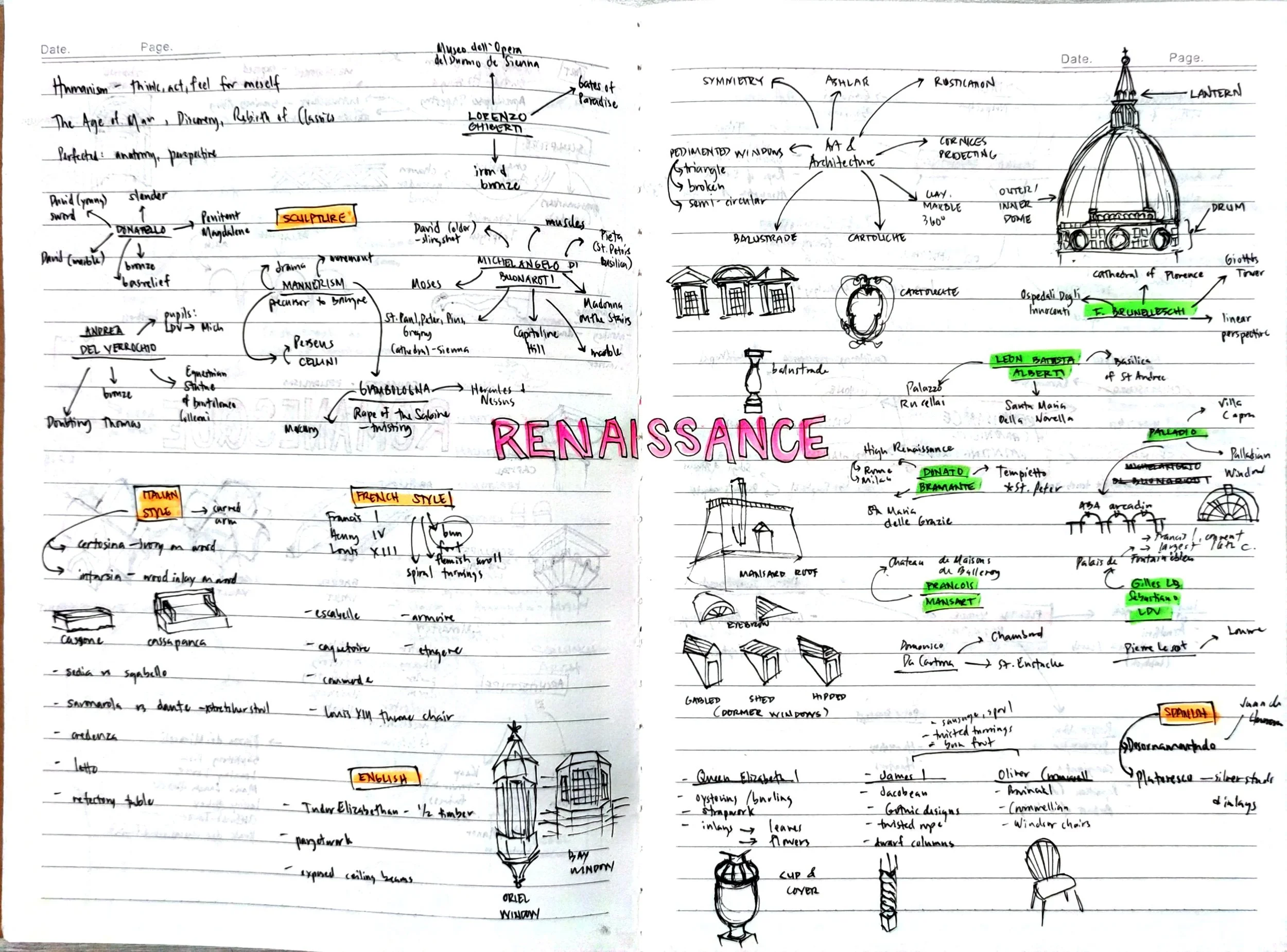
Sample Reviewer of Enna Saniel Duay
Her advice to future examinees goes beyond technique. "Open yourself to your surroundings," she says. "Every space can teach you if you let it. Notice why a layout works, how people move through it, and most importantly, what story it tells. That curiosity builds the mental muscle to think, and trust yourself, as a designer."
Balance Under Pressure: Joel's Story

For IDr. Joel Benitez, last year's class president, preparation was about maintaining balance. His days had a rhythm built around it: mornings were for the gym or a swim, afternoons went to CDEP and review, and evenings were for rest. "A well-rested and healthy mind is just as important as the hours you spend studying," he says.
Highlighting keywords, he found, never worked for him — it never had. "I learn best through reading and writing," he explains, and he studied with instrumental jazz and classical music playing to hold his focus over long stretches.
His core advice is about resisting one-size-fits-all pressure. "Study in a way that works best for you," he says. "Don't let others dictate how you should or shouldn't review, because everyone learns differently." If a method stops working, he says, don't force it — drop it and find one that fits.
He's equally firm about knowing your limits: "Avoid overstudying, and don't force yourself to study when you're already exhausted. More often than not, studying while tired becomes counterproductive.”
He explains his philosophy of balancing study and relaxation — sports, movies, time with friends and family. "If these activities help you relieve stress, recharge, and maintain a healthy balance, make time for them."
What Their Stories Have in Common
Eena and Joel prepared in almost opposite ways — one built an intense, structured rotation; the other about his balance of studying and decompressing. But underneath the differences, a few things hold true for both:
There's no universal method. Both of them explicitly say so — what worked for them might not work for you, and that's fine.
Passive review isn't enough. Eena rewrote her materials by hand; Joel chose writing over highlighting. Both point to active engagement over passive re-reading.
Rest is not optional. Even Eena, with her intense daily rotation, built in variety to avoid burnout. Joel made it part of his entire approach.
Know when to change course.Whether it's dropping a study method that isn't working or noticing when you're too tired to retain anything, both stress the importance of self-awareness over sheer force of will.
What This Means If You're Preparing Next
Every name on our topnotcher list, going back thirty years, started as a student hoping to pass the board exams. Eena and Joel are proof that there's more than one way to get there — through intensity or through balance, through structure or through instinct.
If there's one thing PSID hopes every future examinee takes from their stories, it's this: trust the process you build for yourself, take the training seriously, and remember that the goal isn't just to pass — it's to walk out ready to practice as an interior designer.
